
Home Row Keys: Where Every Fast Typist Starts
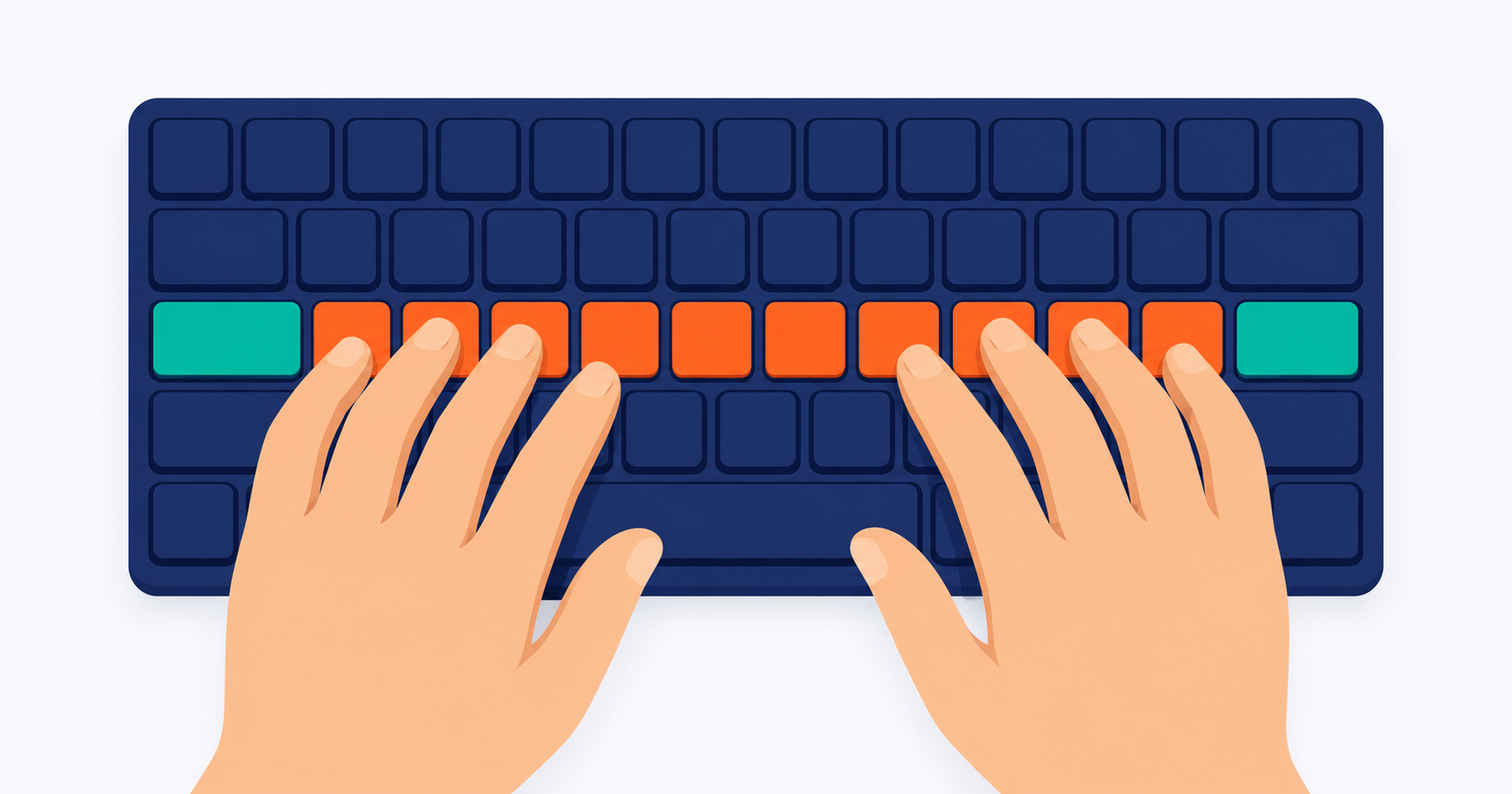
Every fast typist you have ever seen started in the same place: the home row. It is the row your fingers rest on when they are not moving. Learn it well, and the rest of the keyboard becomes easy. Skip it, and you will keep looking down at your hands forever.
This guide keeps things simple. By the end you will know what the home row is, where each finger goes, and how to practise it the right way.
Quick Info Box
What it is: The middle row of letter keys where your fingers rest
Left-hand keys: A, S, D, F
Right-hand keys: J, K, L, and the semicolon
Feel markers: The small raised bumps on the F and J keys
Why it matters: It is the home base for touch typing (typing without looking)
Best for: Complete beginners in Hindi, English, or Marathi typing
What Are Home Row Keys?
The home row is the middle line of letters on your keyboard. Your left hand covers A, S, D, and F. Your right hand covers J, K, L, and the semicolon key. These eight keys are called "home" because your fingers always return to them.
Run a finger over the F and J keys. You will feel a tiny bump on each one. Those bumps let you find the home row without looking. Your two first fingers sit on them, and the other fingers fall into place.
Why the Home Row Comes First
When your fingers start from a fixed spot, they know how far to travel to reach any other key. That is the whole secret of touch typing. You are not hunting for keys. You are moving out and coming back to the same base every time.
Beginners who skip this step type with two fingers and stare at the keyboard. Their speed gets stuck early. Beginners who learn the home row build a steady, no-look habit that keeps getting faster. It feels slow for the first few days. Then it clicks.
How to Place Your Fingers
Rest your left-hand fingers on A, S, D, F. Rest your right-hand fingers on J, K, L, and the semicolon. Keep both thumbs near the space bar. Your wrists stay low and relaxed, not floating in the air.
From here, each finger looks after a small group of keys above and below its home key. You do not need to memorise all of that today. Just get comfortable returning to the home row after every key you press. That return is the habit that matters most.
A Simple Way to Practise
Start slow. Type the home row keys in order, again and again: a s d f, then j k l, then back. Do not look down. Feel for the bumps on F and J to reset your hands. Speed does not matter yet — a calm, correct rhythm does.
Once the home row feels natural, add the rows above and below one at a time. If you type in Hindi, the same idea works for the Remington and Inscript layouts too. Our step-by-step Hindi typing lessons start you exactly here, and the English typing lessons follow the same order. When you are ready to check your progress, take a short Hindi typing practice test.
Turn Practice Time Into Study Time
Here is the part most typing tools miss. On TypingWale, the practice passages are not random lines. They are built from the same material your exam asks about — general knowledge, current affairs, and computer awareness. So the hour you spend fixing your home row habit is also an hour spent reading real syllabus content. You improve your typing and revise at the same time, instead of choosing one over the other.
Common Mistakes to Avoid
The biggest mistake is looking at the keyboard "just this once." That one glance becomes a habit and slows you down for months. The second mistake is rushing. If you push for speed before your fingers know the home row, your accuracy drops and you build errors into your muscle memory. Go slow, stay accurate, and let speed arrive on its own.
FAQ
What are the home row keys on a keyboard?
They are the middle row of letter keys: A, S, D, F for the left hand and J, K, L, and the semicolon for the right hand. Your fingers rest here between keystrokes.
Why do the F and J keys have bumps?
The bumps help you find the home row without looking. You place your two first fingers on them, and your remaining fingers line up automatically.
How long does it take to learn the home row?
Most beginners feel comfortable within a few days of short, daily practice. Building full no-look speed takes a few weeks of steady sessions.
Is the home row the same for Hindi typing?
The resting position of your hands is the same. The letters each key produces change with the layout, such as Remington or Inscript, but the home-row habit carries over to all of them.
Should I focus on speed or accuracy first?
Accuracy first, always. A clean, correct rhythm on the home row builds the muscle memory that lets speed grow safely later.
Type karo. Seekho. Exam clear karo.
Prepare for your exam with TypingWale
Download the free desktop app for CPCT, SSC CHSL, RRB NTPC, and more.
Free Download