
Home Row Keys: The Foundation of Fast, Accurate Typing
A, S, D, F and J, K, L, ; — the eight keys every fast, accurate typist builds on.
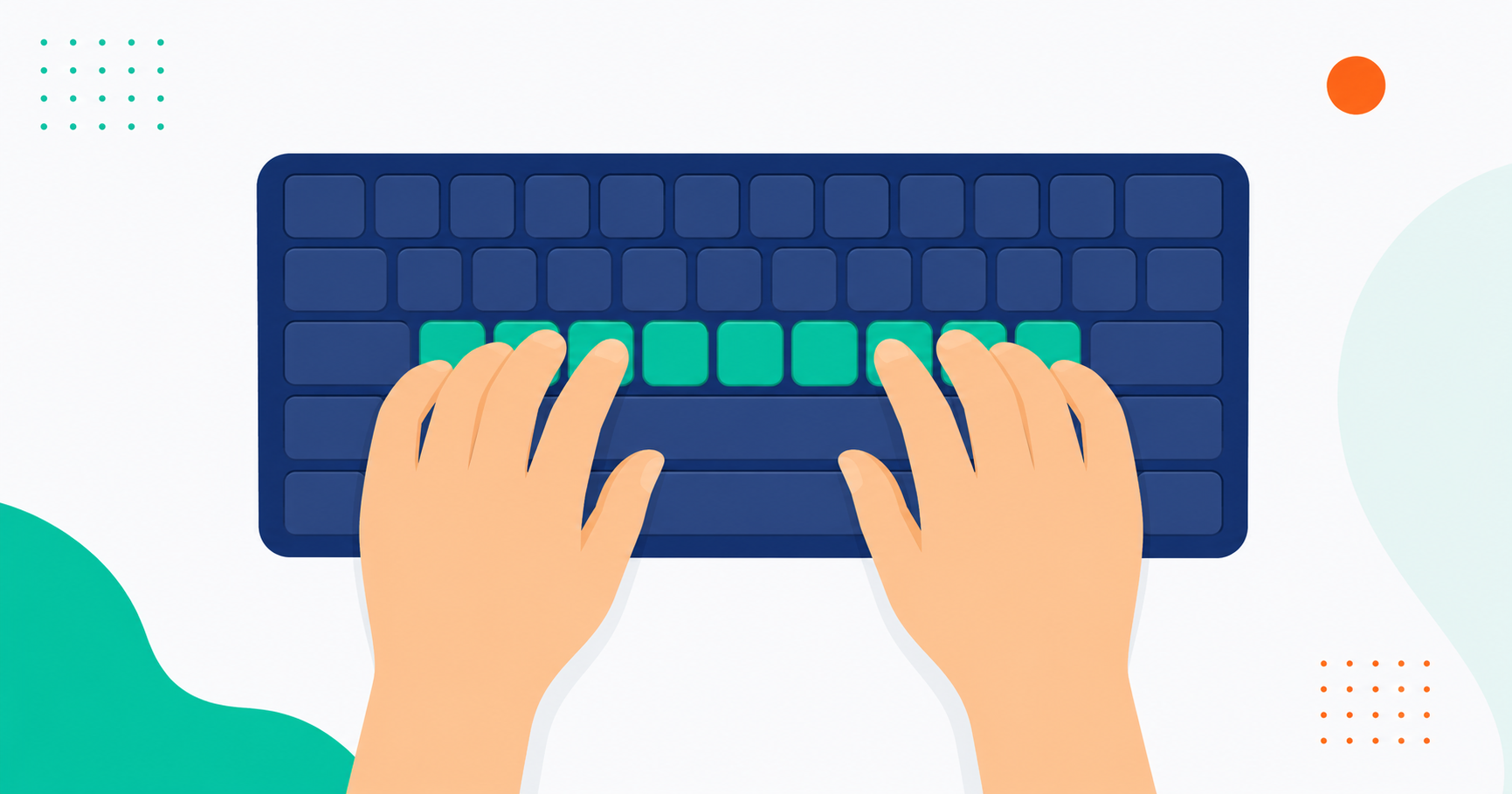
Every strong typist starts from the same small set of keys. They are called the home row. If you learn these keys well, everything else on the keyboard becomes easier. This guide keeps it simple. You will learn what the home row is, where your fingers go, and how to practice it the right way.
Quick Info Box
- What it is: The middle row of letter keys your fingers rest on by default.
- English keys: A, S, D, F on the left; J, K, L, ; on the right.
- Feel markers: Small bumps sit on F and J so you can find home without looking.
- Thumbs: Both thumbs rest lightly on the spacebar.
- Why it matters: It is the base your fingers return to after every key.
- Practice goal: Reach the home row keys without looking at your hands.
What Are the Home Row Keys?
The home row is the middle row of letters on your keyboard. On an English QWERTY layout, your left-hand fingers sit on A, S, D, and F. Your right-hand fingers sit on J, K, L, and the semicolon key. Your two thumbs rest on the spacebar.
Feel the keys with your fingertips. You will notice a tiny raised bump on the F key and the J key. These bumps are there on purpose. They let your index fingers find the correct spot without your eyes. Once your two index fingers land on F and J, the rest of your fingers fall into place.
Why the Home Row Comes First
Think of the home row as your base camp. Your fingers start here, reach out to press other keys, and come straight back. This "reach and return" habit is what lets fast typists move without looking. Their hands always know where they are.
When you skip this step, your fingers wander. You hunt for keys, glance down, and lose your place in the text. That slows you down and adds mistakes. Building the home row habit first fixes both problems at once.
The home row also keeps your effort even. Each finger owns a small group of keys near its resting spot. No single finger does too much work. This keeps your hands relaxed, which matters when a typing test runs for ten minutes or more.
How to Place Your Fingers
Start with your hands loose and your wrists straight. Then set your fingers down one at a time.
Left hand: little finger on A, ring finger on S, middle finger on D, index finger on F. Right hand: index finger on J, middle finger on K, ring finger on L, little finger on the semicolon. Both thumbs stay near the spacebar. That is the full home position.
From here, each finger reaches for the keys just above and just below its own home key, then returns. For example, your left index finger presses F, and also reaches up to R and T and down to V and B before coming back to F. Practice this return motion until it feels automatic.
The Right Way to Practice the Home Row
Go slow at the start. Speed is not the goal yet. Accuracy is. Type the home row keys in order, then in small words, and keep your eyes on the screen, not your hands. Let the F and J bumps guide you back each time.
Short daily sessions beat one long session. Ten focused minutes a day builds the habit faster than an hour once a week. You can begin right now with a browser typing test, and if you want a step-by-step path, the lessons on the learn hub take you from the home row to the full keyboard in order.
Here is a bonus that many aspirants miss. On TypingWale, your practice does two jobs at the same time. The passages are built from real exam material, so one hour of typing is also one hour spent reading syllabus content, current affairs, and general knowledge. You train your fingers and revise your subjects in the same sitting. That is time you would have spent anyway, now working twice as hard for you.
Home Row in Hindi and Other Layouts
The idea of a resting middle row is not limited to English. Hindi layouts also give your fingers a home base, even though the keys produce different characters. If you type in Devanagari, the Hindi typing lessons show you the correct starting position for your layout. If you are focused on English speed and accuracy, the English typing practice page is the place to drill it.
The lesson is the same across every language: learn where your fingers rest, and every other key becomes a short, confident reach.
Frequently Asked Questions
What are the home row keys on a keyboard?
On an English keyboard they are A, S, D, F for the left hand and J, K, L, and the semicolon for the right hand. Your thumbs rest on the spacebar.
Why do the F and J keys have bumps?
The bumps let your two index fingers find the home row by touch. Once F and J are set, your other fingers line up correctly without looking.
How long does it take to learn the home row?
Most people get comfortable with steady daily practice in one to two weeks. Short, focused sessions work better than rare long ones.
Should I look at the keyboard while practicing?
Try not to. Use the F and J bumps to guide your hands and keep your eyes on the screen. This trains the no-look habit that fast typists rely on.
Does the home row apply to Hindi and Marathi typing too?
Yes. Every layout has a resting position for your fingers. The keys differ, but the habit of returning to a home base is the same.
Type karo. Seekho. Exam clear karo.
Prepare for your exam with TypingWale
Download the free desktop app for CPCT, SSC CHSL, RRB NTPC, and more.
Free Download